Category: Features

  • Flickreel’s Best Movies of 2020

    Flickreel’s Best Movies of 2020

    So, 2020… what can I say that hasn’t been said already? There’s no denying that this will go down as one of the most stressful years in modern history, but was 2020 a bad year for movies? Well, it was a frustrating year on the cinematic front. From March onward, it feels like a day hasn’t gone by without news about another tent-pole release being delayed. Some were ultimately sent directly to streaming platforms, others tried to reignite the box office, and several explored both venues. Many potential blockbusters have been shelved until 2021, although it remains uncertain if theater chains will recover by this time next year or ever.

    While the future isn’t set in stone, 2020 is officially in the can. For all the hardships this year brought, the movies did help us get through it, even if we didn’t get to experience all of them in a packed theater. Although we’ll have to wait longer to see Black Widow, Ghostbusters: Afterlife, and various others, 2020 gave us so many great films that it’s hard to call this a bad year for the medium. Some of them reflected the madness of 2020, others helped take our minds off 2020, and today we’re going to discuss the best 2020 had to offer.

    After much consideration, I’ve decided not to include Hamilton since it’s technically a live stage recording. If I were willing to bend the rules, however, this musical sensation would fit in comfortably around the #5 spot. I fear I may be throwing away my shot, but I think my 10 picks will leave you more than satisfied nonetheless.

    10. Minari

    The best movies don’t always follow a conventional three-act structure. Minari simply shows a Korean-American family living their lives as they adapt to a new home. That may sound straight-forward, but the places Lee Isaac Chung’s film takes us to are never short of profound. It’s carried by a wonderful cast, the two highlights being little Alan Kim and screen legend Youn Yuh-jung.

    9. Sound of Metal

    Sound of Metal may be the best movie about the deaf experience since Children of a Lesser God. Riz Ahmed gives a heartbreaking performance as a drummer who loses his hearing and much more on his reluctant road to acceptance. Paul Raci and Olivia Cooke are equally strong as his deaf mentor and girlfriend, respectively, but the real star of Darius Marder’s film is the brilliant sound design.

    8. Wolfwalkers

    From The Secret of Kells, to Song of the Sea, to The Breadwinner, Irish animation studio Cartoon Saloon has only gotten better with each new feature. Wolfwalkers might be their masterpiece, telling a timeless story about friendship and following your own path. It’s all executed with a stunning 2D style that pops out at the audience with every shape and color.

    7. Palm Springs

    After Groundhog Day, Edge of Tomorrow, Happy Death Day, and numerous others, you’d think that the time loop genre would start emitting déjà vu. The characters are what make each of these movies unique, however, and Palm Springs has two winning leads in Andy Samberg and Cristin Milioti. Andy Siara’s screenplay, Max Barbakow’s direction, and a slick editing team further make for one of the year’s most original romances, as well as a thoughtful story about maturity.

    6. The Invisible Man

    Who would’ve guessed that a contemporary version of The Invisible Man would wind up being among the year’s most enthralling entertainments? Of course, when you have a filmmaker like Leigh Whannell, a leading lady like Elisabeth Moss, and a cinematographer like Stefan Duscio, familiar source material can catch you off guard around every turn. What makes the film especially eerie is its real-world parallels concerning abusive relationships and rapidly advancing technology, making a stalker in an invisibility suit seem practical.

    5. Promising Young Woman

    Behind its inviting candy colors, Promising Young Woman is one of 2020’s darkest comedies. Much like a box of chocolates, though, you never know what you’re going to get. Emerald Fennell’s debut feature is indeed a revenge thriller with a quirky edge, just as the trailer promised. Fennell’s recipe is made up of several unique ingredients, however, one of which is Carey Mulligan, who has never been more invigorating to watch. The film ultimately leaves you with a devilishly delicious taste in your mouth.

    4. Da 5 Bloods

    Spike Lee won his first competitive Oscar for co-writing BlacKkKlansman. He deserves to win another for directing Da 5 Bloods. While Do the Right Thing remains Lee’s best film, Da 5 Bloods might be his most well-made and well-acted. Delroy Lindo has been doing strong work as a character actor for decades and he turns in a career-best performance here as a former soldier forever haunted by his past. His character arc accumulates with a deeply emotional scene featuring Chadwick Boseman in one of his last performances.

    3. One Night in Miami

    What happens when you put Malcolm X, Jim Brown, Sam Cooke, and the athlete formally known as Cassius Clay in a room together? You get one of the most passionately written, exquisitely acted, and masterfully directed films of the year. 2020 gave us several powerful movies about the black experience, although few were more thought-provoking than One Night in Miami. Regina King and Kemp Powers have made a film well-worthy of the four legends at its core.

    2. The Trial of the Chicago 7

    Almost a decade after the Social Network, Aaron Sorkin has written another thoroughly gripping drama charged by his rapid-fire dialogue. Sorkin also gets behind the camera this time in what’s easily his finest directorial achievement. Between Yahya Abdul-Mateen II, Mark Rylance, Eddie Redmayne, Jeremy Strong, and Frank Langella, you could easily pack the Best Supporting Actor lineup with this film’s cast, although my favorite is Sacha Baron Cohen as Abbie Hoffman.

    1. Soul

    What’s the meaning of life? It’s a question we’ve pondered for eons and the answers found in Pixar’s latest triumph range from humorous, to inventive, to wise. It’s only fitting that Soul would be released on Christmas Day, serving as a reminder that, despite the countless struggles we must endure, it truly is a wonderful life. In a year like 2020, you couldn’t ask for a more meaningful message or a more delightful film to get that message across.

    Honorable Mentions (Alphabetically)

    Ammonite
    Borat Subsequent Moviefilm
    First Cow
    Get Duked!
    I’m Thinking of Ending Things
    I’m Your Woman
    Ma Rainey’s Black Bottom
    Mank
    News of the World
    Nomadland
    On the Rocks
    Over the Moon
    Pieces of a Woman
    Tenet
    Wonder Woman 1984

  • Did audiences miss the best show on Amazon Video?

    Did audiences miss the best show on Amazon Video?

    As far as original content goes, Amazon Video has struggled to keep up with Netflix’s vast library of game-changing shows. They’ve also fallen behind Hulu in terms of awards recognition, what with The Handmaid’s Tale dominating the Emmys. Nevertheless, Amazon has still left its mark on the streaming scene with shows like Mozart in the Jungle, The Man in the High Castle, and of course Transparent. Interestingly enough, though, some of their best material isn’t exclusively aimed at adults, but at family audiences.

    Over the past several years, television has brought us a plethora of brilliant shows primarily aimed at kids, including Adventure Time, Steven Universe, and Gravity Falls. Of course one thing those three shows have in common is that they’re all animated. Meanwhile, live-action kids shows generally comes off as lazy and uninspired. That’s not the case with Amazon, which has delivered a slew of inventive, engaging live-action programs for families, from Just Add Magic to The Kicks. The best of the best would have to be a lost treasure called Gortimer Gibbon’s Life on Normal Street.

    When I say “best of the best,” I don’t just mean the best Amazon kids show. I mean the best original show on Amazon Video period. If I had to name my personal favorite steaming service shows overall, Gortimer Gibbon’s Life on Normal Street would be right up there with Stranger Things and Unbreakable Kimmy Schmidt. Yet, whenever I recommend this gem to people, I always get the same questions: “How come I’ve never heard of that show?” “What’s it about?” “Why is it so special?”

    I can’t give a definitive answer to first question, although the marketing might be the most obvious reason why the show didn’t find a larger audience. As for what it’s about, the series naturally revolves around Gortimer and his friends as they have various adventures on Normal Street. Just as Regular Show is anything but regular, Normal Street is anything but normal. As for why it’s so special, where do I begin?

    Like the main character’s name, the series is quirky and utterly unique. As fantastic as Gortimer’s life is, there’s also a layer of brutal reality that sneaks up on the audience. Many episodes start out like a daydream: lighthearted, whimsical, fun. While some stories build up to a happy ending, others force us to accept the challenging fact that life doesn’t always work out the way we want. There’s a certain point in our childhoods where anything seems possible and another point where we realize that there’s not going to be an easy solution to everything. Somewhere in between these two points, you get Gortimer Gibbon’s Life on Normal Street.

    David Anaxagoras’ creation is often compared to Eerie, Indiana and The Adventures of Pete and Pete. To me, the show that it has the most in common with is The Twilight Zone. While Gortimer isn’t an anthology series, its colorful world makes leeway for countless scenarios. While The Twilight Zone is often remembered for aliens and pig-nosed people, each episode had something meaningful to say about humanity. Something similar can be said about Gortimer Gibbon’s Life on Normal Street, which encompasses both the magic of childhood and the raw honesty of childhood.

    Beyond that, it’s hard to talk about why the show is so special without zooming in on some key storylines. So here are the Top 10 Episodes! Keep in mind that there will be a few spoilers ahead, so maybe just stop reading this article and go watch the show:

    1. Gortimer, Mel, Ranger, Catherine and the Student Identity Crisis

    As strong as the writing and directing was, this show never would’ve succeeded without its gifted young cats. This episode allows everyone a chance to play against type, as a student ID card machine creates a fiasco right out of Freaky Friday. The body swap setup not only amounts to some great comedy, but also some strong character development that makes everyone feel more fleshed out by the end.

    1. Ranger and the Legend of Pendragon’s Gavel

    Although Mel is clearly the most qualified candidate for student council president, everyone begins to aimlessly follow Ranger, whose victory appears to be tied to a strange gavel. Gortimer and the gang come across a variety of mystical trinkets throughout the series and the gavel has one of the most legendary backstories, making for one of the show’s most humorous and creative outings.

    1. Gortimer and the Surprise Signature

    After finding a signature on his cast from someone named Abigail, Gortimer sets out to put a face to the name. This episode not only delivers an engaging mystery, but also marks the beginning of a legitimately cute romance. While Gortimer and Abigail might not live happily every after, their ongoing relationship over the show’s course truly captures the sensation of first love.

    1. Gortimer and the Mystical Mind Eraser

    When Gortimer is lead to believe that Mel has a crush on him, he decides to acquire a mind-erasing pencil to salvage their friendship. However, he has a change of heart after meeting the pencil’s owner (Luke Matheny, also the episode’s writer), who has erased so many bad memories that he can barley function in the world. Much like Eternal Sunshine of the Spotless Mind, this episode wisely demonstrates why some of the most painful memories are also the most important.

    1. The Mystery of the Blood Moon Eclipse

    In honor of the blood moon eclipse, Mel invites the gang over for a slumber party to swap scary stories. When an eerie presence emerges, though, the sleepover becomes a ghost story in itself. This episode will keep you guessing from start to finish, complete with a chilling buildup and a clever payoff.

    1. The Mystery of the Marlow Mansion

    Like the previous episode, this episode sucks the audience in with its wonderful sense of mystery and doesn’t let us down with its final destination. At a whodunit party, Gortimer’s friends are taken over by the personas of their characters. The only way to restore everyone back to normal is to narrow down the suspects and find the culprit behind a robbery. Think Clue Jr., but with an inspired twist.

    1. Gortimer vs. the Relentless Rainbow of Joy

    For much of the first season, Gortimer’s dad is only mentioned in passing. This episode provides a deeper look at their relationship and the results will resonate with any child that’s been effected by divorce. Although he loves his children, Gortimer’s father has an important, demanding job that requires him to be away. When a rainbow hits Normal Streets, however, he’s motivated quit his job and spend more time with his family. While this seems like a dream come true, Gortimer soon comes to learn that sometimes we need to sacrifice our happiness for the greater good. The lesson at the end of this rainbow might be bittersweet, but it’s one every young adult should take to heart.

    1. Gortimer, Ranger and Mel vs. the Endless Night

    There are some moments we want to last forever. When Gortimer, Ranger, and Mel wish for their camping trip to never end, they find themselves in a perpetual state of childhood innocence. The longer they stay in this time loop, though, they begin to realize that life isn’t about standing still. It’s about moving forward, even if we’re afraid of what’s to come.

    1. Mel vs. the Future

    This show was never afraid to tackle heavy issues, but it came as a complete shock when Mel found out that her mother died. In the same vein of The Bridge to Terabithia, Mel vs. the Future is a haunting and authentic depiction of how children respond to death. That might sound odd, seeing how the episode also incorporates time travel into the mix. Even with the element of sci-fi, however, Mel’s emotional journey couldn’t be more relatable, as she endures the five stages of grief. Devastating, poignant, and not condescending in the least, it’s an episode that hits the audience hard and leaves you reaching for the tissue box.

    1. Gortimer vs. The End

    With Gortimer’s last day on Normal Street looming, the trio that started it all decides to put their most treasured mementos in a time capsule, leading to several fun callbacks. The time capsule comes to represent everything Gortimer has to let go of in order to move on. As difficult as this proves for Gortimer and his friends, they ultimately discover that the memories they made will last forever. Even then, however, saying goodbye is never easy and this episode epitomizes why. Just as Gortimer isn’t ready to bid Normal Street farewell, neither is the audience. As Gortimer rides off to his new life, we’re reminded why this shows deserved to last so much longer than two seasons. At the same time, though, at least we can take comfort in the fact that the series didn’t overstay its welcome and ended on just the right note.

  • Fantastic Beasts and Where to Find Them – “Ilvermorny School of Witchcraft and Wizardry” Video

    Fantastic Beasts and Where to Find Them – “Ilvermorny School of Witchcraft and Wizardry” Video

    The latest video from Fantastic Beasts and Where to Find Them uses stylish animation to show off America’s school of magic, better known as the Ilvermony school of Witchcraft and Wizardry.

  • Fantastic Beasts and Where to Find Them – Wand Training Featurette

    Fantastic Beasts and Where to Find Them – Wand Training Featurette

    The adventures of writer Newt Scamander in New York’s secret community of witches and wizards seventy years before Harry Potter reads his book in school.

  • The BFG – Mark Rylance Featurette

    The BFG – Mark Rylance Featurette

    Disney has released a new featurette for The BFG which focuses on Mark Rylance’s character.

  • The Jungle Book – Voices of the Jungle Featurette

    The Jungle Book – Voices of the Jungle Featurette

    Bill Murray, Giancarlo Esposito, Christopher Walken, Lupita Nyong’o, Ben Kingsley, Scarlett Johansson, and Idris Elba discuss their voiceover roles in Jon Favreau’s The Jungle Book.

  • The Green-Light | Why one scene in Jurassic World almost made me like it as much as the original

    The Green-Light | Why one scene in Jurassic World almost made me like it as much as the original

    Welcome to The Green-Light, a new column from Gary Green. Find within spittle-flecked passion and encyclopaedic insight on everything to do with the movies.

    I love practical effects. I also love CGI, when it’s done right. Truly great effects can transport you further into the world of the movie, helping to create living, breathing characters in-frame who are as tangible as the actors they’re appearing next to, whether it be the binary wizardry of Gollum in The Lord of the Rings, or Jeff Goldblum’s slimy, grimy real-effects transformation in The Fly. But you know what I really love? Dinosaurs. Big, hulking, beautiful dinosaurs, ambling about and roaring like nobody cares, who sometimes try to eat Jeff Goldblum in Steven Spielberg’s 1993 family adventure movie Jurassic Park. I rewatched the movie recently in the wake of all the hype surrounding its third sequel, Jurassic World (you mean you haven’t yet?) where our 65 million-year-old friends get up to no good once more – and something struck me more than any of the other million times I’d seen it.


    Let's visit just one more time.
    Let’s visit just one more time.

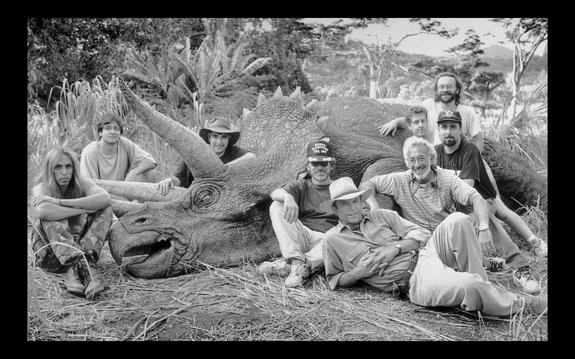
    Jurassic Park really helped boost CGI in a big way for blockbusters, masterfully blending it with the practical effects to fill in the gaps, as it were (this is especially the case with the night-time Tyrannosaurus Rex sequence). But there’s one scene in particular that hit me as particularly moving and memorable – and there were none, or at the very least minimum, computer effects used in it. It’s the moment when Ellie, played by Laura Dern, runs over to a Triceratops in the tall grass; after being wowed by the beauty of the gentle beast, she realises that the creature is in pain – and it looks it, too. With the Triceratops writhing in agony, and Dern’s wonderfully expressive face helping us along, we’re drawn completely into the scene, and end up caring deeply about something that has been extinct for a near-incomprehensible amount of time. Why is this? Because the Triceratops is actually there; it’s physically in the scene, with Stan Winston’s incredible animatronics reacting to Dern in the shot. It’s a heartbreakingly vulnerable moment, and it works because your brain – the smart thing that it is – recognises the effect as real. And that’s because it actually is.

    Stan Winston's team, who brought the JP Triceratops to life. Steven Spielberg and Sam Neill pictured.
    Stan Winston’s team, who brought the JP Triceratops to life. Steven Spielberg and Sam Neill pictured.

    This astonishing scene is mirrored somewhat in Colin Trevorrow’s Jurassic World, which is still dominating the worldwide box office as we speak. When Chris Pratt’s character, Owen, approaches a horizontal Apatosaurus (spoiler warning), we see that It’s just been ravaged by the loose Indominus Rex which is wreaking havoc around the park; what you see are its eyes looking upward at Owen and Claire (Bryce Dallas Howard), terribly hurt and dying from its wounds. As far as I can tell, the dinosaur’s head is a practical effect, potentially with a touch of gentle CGI accentuations to its expressions blended expertly in. What entails is a remarkably tender moment, one that almost brought tears to my eyes the same way the Triceratops did in Jurassic Park, and one that I would class as a genuinely magic movie moment (the ever-rare Triple-M). Perhaps my emotions were somewhat compensating, as the scene is placed in the middle of a film that’s dominated by polygons and ones and zeroes, and gigantic computerised set pieces rather than quiet moments like this one. Regardless, it stands out, and it stands out for a reason.

    Apatosaurus. Or, I've-just-got-some-dust-in-my-eye-osaurus.
    Apatosaurus. Or, I’ve-just-got-some-dust-in-my-eye-osaurus.

    If the rest of Jurassic World were like this, then it may have gotten close to the original’s brilliance. Yes, the computer generated effects are top of the range, for the most part. But that’s all that our brains register them as: effects. Not reality. There’s an intelligent meta-commentary on sequelitis bubbling under the film’s surface, too; it’s a movie that’s much more than a dumb action flick. Jurassic World is a fun adventure thriller, and I wouldn’t hesitate taking my own kids to see it (if they existed) – but there’s one movie I’d show them first.

  • The Master of the Light: Andrew Lesnie’s greatest moments

    The Master of the Light: Andrew Lesnie’s greatest moments

    Following his death, there’s been an outpouring of love for cinematographer Andrew Lesnie’s work from film fans all over the world. Best known as the man who shot Middle-Earth, he worked with Peter Jackson on the Lord of the Rings films (and the latest Hobbit trilogy to boot); but apart from giving New Zealand’s tourism industry a bump up the backside, he also had extraordinary achievements elsewhere. From kids flicks such as Babe and its sequel Babe: Pig in the City, to framing superstar Will Smith in box office smash I Am Legend, to letting us watch an army of primates take over the world in Rise of the Planet of the Apes, he was clearly a man who understood the medium of cinema, and how to get only the very best results.

    His final movie, The Water Diviner – directed by and starring Russell Crowe, who called him a ‘master of light’ when he learned of his death – gave him a chance to show us just some of the horrors of WWI, and serves as a potent reminder that Lesnie really knew how to shoot movies. From the very beginning of storyboarding, to the the film set itself, right until the end of post-production, the director is the brain of the entire project – and the cinematographer is very much the eyes. Those who have worked with Lesnie, such as Jackson and Ian McKellen, have commented on what a gentle, kind soul he was to be around; for the rest of us, all we have are his films. Here, we’ll look briefly at some of the director of photography’s greatest moments, from across his incredible body of work.


    The Isengard Dive

    During the pre-production on The Lord of the Rings trilogy, the ingredient that was clearly the most important was the world-building; how do you tell a story well, while also building a sprawling, mythical world around it? Throughout these movies, there are a countless number of breathtaking shots – but one in particular, in the first half of 2001’s The Fellowship of the Ring, proved that Jackson and co. were really onto something. The camera gently ascends the great tower of Orthanc, overlooking the charred landscape of Saruman’s domain before coming to a rest by Gandalf, imprisoned at the monuments’ summit in the serene moonlight, until we’re dropped 500 feet feet all the way back back down into the fiery bowels of Isengard. Lesnie let Jackson’s imagination run wild, and this shot – where the sides of good and evil in Middle-earth are sublimely portrayed – was just the beginning of a partnership that would only get more epic (and earn Lesnie an Oscar in the process).

    https://www.youtube.com/watch?v=tnidHtNzK-0


    Greeting at Skull Island

    Following the multiple-year odyssey that was making The Lord of the Rings movies, Lesnie signed up for some more insanity with Peter Jackson on 2005’s King Kong. The film starts in a near-fantastical New York City, its immense CGI backdrops shadowing colourful characters who could have been pulled from a comic strip – but when we finally reach Skull Island, the dreaded abode of the gargantuan gorilla Kong, a nightmare becomes sickening reality. When the intrepid film crew explore the desolate village, they’re greeted by murderous natives; the entire sequence is shot with a stark objectivity, accentuated by the REM-inspired stuttered-frame motion Lesnie perfected in The Fellowship of the Ring, all layered with the kind of grim hues that chill to the very bone. Remind us never to visit Skull Island for a holiday.

    https://www.youtube.com/watch?v=R_tx6q_F5Hc


    Turning Reality into Dream

    Both Babe movies were the reason that Jackson handpicked Lesnie for The Lord of the Rings; in the director’s own words, he chose him for ‘the way he’d used backlight and the sun and natural light to create a very magical effect. And Babe had that larger-than-life feel about it that I wanted.’ (It certainly paid off for Jackson.) In Babe’s 1998 sequel, the mundane is certainly turned into something magical – but it wasn’t just because of the talking animals. Lesnie shot George Miller’s gigantic city sets with a dreamlike quality, basking their clear artificiality in a keen self-awareness that make it stand out as a wonderfully crafted family film. You can see Pig in the City’s influence on later kids’ flicks, like Charlotte’s Web (also about a pig), and Nanny McPhee, where both injected a little absurdity into normality.

    https://www.youtube.com/watch?v=al91hfncfC4


    Streets of Rage

    I Am Legend is evidence that even though the movie may not be great, Lesnie could still make it look so. The joy to be had from watching this 2007 Will Smith vehicle is in its opening act, where we get to learn about the world that he occupies – a world with no people, but plenty of night-stalking vampires. Drenched in warm sun beams, New York City is turned into a silent but beautiful oasis of concrete and solitude; here, Lesnie allows the buildings to loom over Smith, getting us to really feel that, despite the quiet, someone is always watching us. He would also get some of Francis Lawrence’s better ideas to shine through; that absurdly creepy shot of the mannequin in the empty road (see below) serves as a particular highlight of when a director’s vision and a DP’s talent come together perfectly.

    https://www.youtube.com/watch?v=_tts6_LpGnk


    Light versus Dark

    The Lord of the Rings, on paper and on screen, is about the mighty struggle between good and evil. Having to keep reminding audiences of that over three films would seem a chore for the director, and an even bigger labour for the audience. Of course, if you had Andrew Lesnie as cinematographer on your picture, then visual storytelling would become a succinct and elegant affair, even when blown to epic proportions. Just like that incredible camera swoop from the bowels of Isengard to the skyward tip of Orthanc in Fellowship, another indelible image comes in 2003’s The Return of the King, when Gandalf bounds across the Pelennor fields to rescue the remaining guard of Gondor from flying Nazgul snapping at their heels. The wizard’s staff blasts a ray of light at the dark creatures, a shield for the fair whites and greens of Middle-earth against the ash clouds of Mordor. This image could hang as an oil painting in a cathedral, a stunning mural depicting light battling darkness, a sequence that could easily have come across as preposterous; Lesnie was always able to find a way of framing Jackson’s rampant imagination with a point-of-view that stunned, rather than fatigued, the audience.

    https://www.youtube.com/watch?v=Owq_aBJ9G6Q


    Reclaiming the Homeland

    Even though CGI had almost become an assumed standard by the time The Hobbit movies rolled into production, Andrew Lesnie was always able to give these binary creations a living, breathing world to live in. Case in point: Erebor, from The Hobbit films. First glimpsed in 2012’s An Unexpected Journey, we got to fully explore the lost domain of the Dwarves in 2013’s The Desolation of Smaug – and Lesnie realised that the visuals for the sequel had to be even bigger than the first time round. An immeasurably vast underground city of marble-green architecture, awash with colossal rivers of gold, it’s in the echoey city of Erebor that Bilbo meets his first live dragon, Smaug. You may think that it’s Smaug’s personality which fills these empty halls – but rather, it’s the very grandiosity of Erebor that gives the winged serpent the stage to slather Bilbo with his evil-hearted spiel in the first place.


    Gallipoli

    Lesnie’s final film, The Water Diviner, will remain a worthy testament to the man’s astonishing cinematography. Its standout sequences are set during the Battle of Gallipoli, one of the bloodiest events in the history of any war – but it’s not the subject alone that gives weight to proceedings. Mainly shot at night, Gallipoli’s darkest moments (literally and figuratively) are captured poetically, as Lesnie’s flair for hushed light allows long, deep shadows to cast themselves across not only the bullet-hewn battlefield, but the desperate faces of the soldiers too. In Lesnie’s hands, both landscapes become maps of madness and despair in the face of such breathtaking violence. There’s only so much credit Russell Crowe can take for The Water Diviner’s most visually arresting, emotionally gripping moments before it becomes clear that Lesnie – ‘the master of the light’, as Crowe himself put it – was just as responsible for them as the director himself.

  • Flickreel’s 2014 Oscar Predictions

    Flickreel’s 2014 Oscar Predictions

    It’s that time of year again to celebrate the very best of the past year in film, with the prestigious 86th Academy Awards soon to be upon us. As we all prepare to settle in for the night, and ridicule the red carpet coverage and then open up the dolly mixture and marvel in the ceremony itself, beforehand let’s run through some of our 2014 Oscar predictions.

    Best Picture – 12 Years a Slave
    Sometimes it shouldn’t just be the best film of the year to take home the grand prize, but the most significant film. With Steve McQueen’s picture about as definitive as you could be about slavery, there’s a general feeling that 12 Years a Slave needs to win this award, and similarly to what Spielberg achieved with Schindler’s List exactly 20 years ago, you’d be hard pushed to look past that from happening again.

    Best Actor – Matthew McConaughey (Dallas Buyers Club)
    Dallas Buyers Club may not be triumphant in many other areas, but the one place where success is likely, and certainly deserved, is within the fine acting performances. With McConaughey enjoying an incredible recent run of form, it seems that it could all culminate in him taking home the award for Best Actor, and it would be one which was throughly deserved.

    Best Actress – Cate Blanchett (Blue Jasmine)
    This one feels like something of a foregone conclusion, as Blanchett’s superb, nuanced performance in Woody Allen’s Blue Jasmine is head-and-shoulders above any other performance from a leading actress this past year. It’s layered and emotional, and about as safe a bet as you could place this year.

    Best Actor in a Supporting Role – Jared Leto (Dallas Buyers Club)
    It would seem somewhat wrong for McConaughey to win Best Actor and for his co-star Jared Leto to leave empty handed, so there’s a good chance that the pair will both be triumphant at the forthcoming event. For an actor that makes so few films – focusing heavily on his musical career the past few years – he doesn’t seem rusty in any way shape or form, bringing such humility to his role of Rayon, a transvestite AIDs sufferer.

    Best Actress in a Supporting Role – Jennifer Lawrence (American Hustle)
    Hollywood’s sweetheart Jennifer Lawrence was of course the winner of the Best Actress award last year, and it’s likely she’ll leave triumphant for a second consecutive time. Bringing a wonderful degree of humour and volatility to her role in American Hustle, there’s a strong chance she’ll be the only winner from a film blessed with a series of fine acting performances.

    Best Animated Feature – Frozen
    This Disney musical is about as classic as an animation can be: it’s a nod to some of the studio’s brilliant pictures of old, while feeling unique in its own right. With a handful of wonderful songs and characters to truly invest in – Frozen was the strongest animation to come out this year. However a mention must also be reserved for the French cartoon Ernest & Celestine, which shows off the Academy’s eye for impressive productions from across the globe.

    Best Directing – Alfonso Cuaron
    Gravity may be a flawed piece in some regards, but if there is one area you simply couldn’t criticise the film, it’s within its directing, which is a truly astounding feat of filmmaking. To make the viewer genuinely feel as though they’re witnessing a film that is set up in space is an incredible achievement, and Cuaron must be recognised accordingly.

    Best Documentary – The Act of Killing
    Not only is The Act of Killing one of the finest documentaries of the past year, but it’s about as good as the genre has offered in the past decade at least. Joshua Oppenheimer’s incredible picture explores the world of legalised killings in Indonesia, as he visits some of the former gangsters and asks them to reenact their murders in any way they see fit. It’s as absurd and memorable as it sounds – and for that reason it would be a huge surprise if it didn’t win the Oscar.

    Best Foreign Language Film – The Hunt
    Though for British audiences The Hunt seems like something of a distant memory, having hit our screens close to 18 months ago, given it’s release date in the US, it’s only now qualifying for the Academy Award. Given the ingenuity and complete devastation on show in this Danish production by Thomas Vinterberg, Mads Mikkelsen’s incredible performance as a wrongly accused paedophile makes for a film that is difficult to forget, and certainly the frontrunner for the award.

    So there we have it: our predictions for the Oscars. Be sure to check back on Flickreel after the event, where we can provide our coverage of the ceremony and either boast about the ones we got right, or hold up hands up to the ones we got wrong… Here’s hoping for more of the former!